
Notified of a GOMOR and need to respond?
Receiving a GOMOR can be stressful. You may have questions about what it means for your career, what your options are, and how to respond. With a limited response window, it’s important to understand your deadline and begin developing a plan early.
The information below can help clarify the process. Still have questions or feel unsure about your next step? Schedule a free 30-minute consultation with me. We can discuss your situation, explore your options, and help you make sense of what comes next.
Take Back Control
My philosophy is simple: you should understand what is happening, know your options, and have a voice in what comes next. At Helmsing Military Law, you work directly with me, Natalia Helmsing, to build a clear plan. Then I put that plan into action as a vigorous advocate for you, your career, and your future.
What Happens When You Get a GOMOR? Understanding the Army GOMOR Process
By Natalia Helmsing | Helmsing Military Law, PLLC
Receiving a General Officer Memorandum of Reprimand (sometimes called GOMOR or GOMAR) can be one of the most consequential administrative actions a Soldier faces during an Army career. But receiving a GOMOR does not necessarily mean that it will become a permanent part of your military record, and it does not automatically mean that your career is over.
The period immediately after receiving a GOMOR is important because, in most cases, the Army must give you an opportunity to review the unfavorable information and submit matters on your own behalf before a final filing decision is made. What you submit during that process can affect whether the reprimand is filed permanently in your Army Military Human Resource Record (AMHRR), kept locally for a limited period, or not permanently filed at all. AR 600-37 specifically requires consideration of a Soldier's response before a final AMHRR filing decision.
What Is a GOMOR?
A GOMOR, or General Officer Memorandum of Reprimand, is an administrative reprimand issued by a general officer. It is a formal written statement expressing disapproval of a Soldier's conduct. Importantly, an administrative GOMOR is not punishment under Article 15 of the Uniform Code of Military Justice. AR 600-37 actually requires a memorandum proposed for filing in the AMHRR to state that it is imposed as an administrative measure rather than punishment under Article 15. That distinction does not make a GOMOR insignificant. The Army's current command legal handbook warns that a reprimand filed in a Soldier's AMHRR can contribute to consequences including non-selection for promotion, removal from a selection list, a bar to continued service, administrative separation, or other adverse personnel action.
In practical terms, the most important question after receiving a GOMOR is often not simply “Did I receive a reprimand?” It is:
Where will the GOMOR be filed?
What Happens After You Receive a GOMOR?
For most GOMORs, receiving the memorandum begins a process rather than ending one.
You Receive the GOMOR and the Basis for It
When unfavorable information is being considered for filing in your AMHRR, AR 600-37 generally requires that you have an opportunity to review the documentation forming the basis for the proposed filing. The regulation requires redactions to be kept sufficiently limited to permit a meaningful rebuttal. For a reprimand proposed for AMHRR filing, the referral should identify applicable portions of investigations, reports, and other documents relied upon as the basis for the reprimand, unless you were previously given an appropriate opportunity to respond to that information. That means the first step should be to carefully examine both the allegations in the GOMOR and the evidence supporting them.
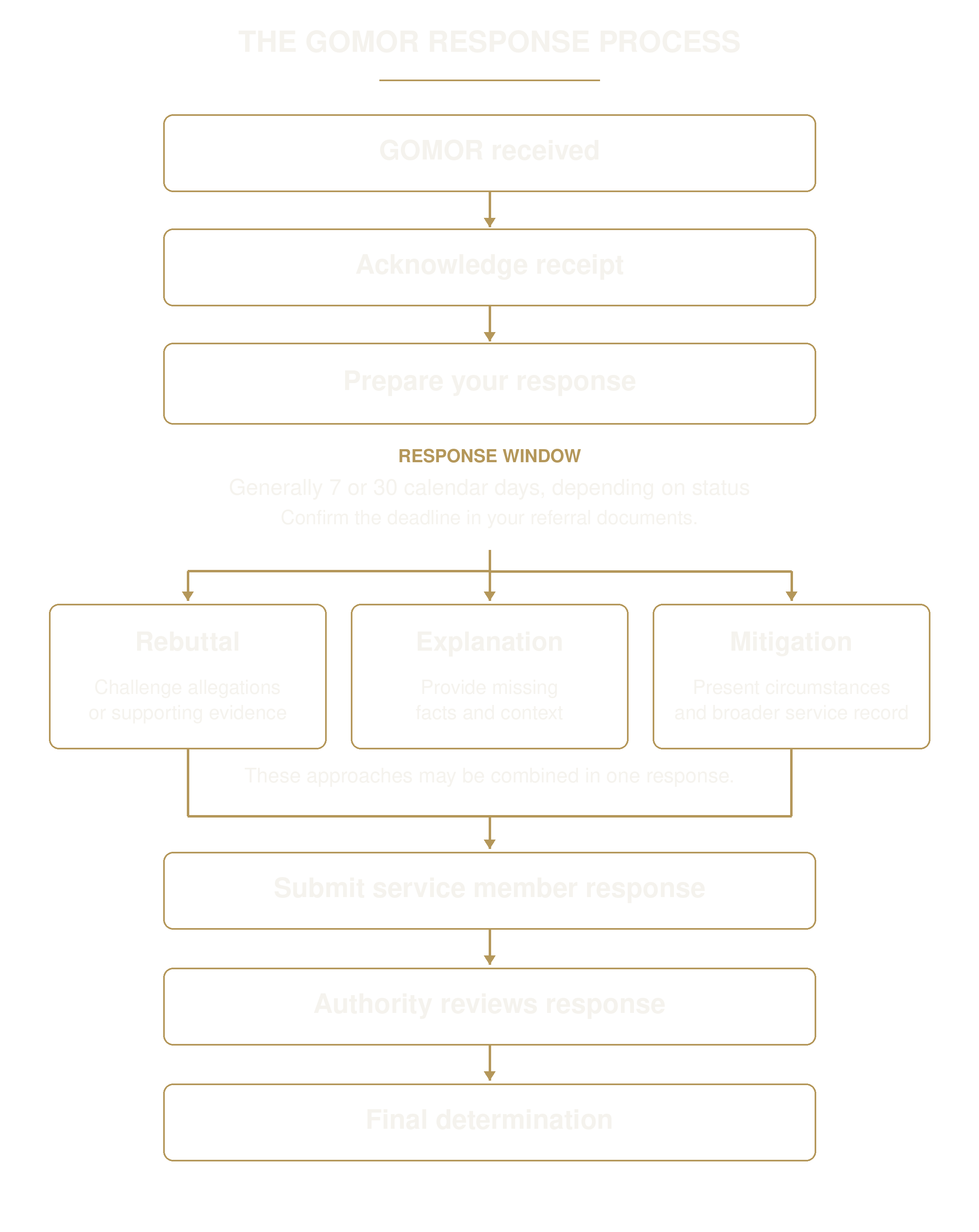
You Acknowledge Receipt
You will normally be asked to acknowledge the GOMOR and your opportunity to respond. An acknowledgment should not be confused with an admission that the allegations are true. AR 600-37's prescribed acknowledgment language essentially confirms that the Soldier has read and understands the unfavorable information and either intends to submit matters or declines to do so. Refusing to sign generally does not stop the process. If a Soldier refuses to acknowledge the referral, the reprimanding official may document the refusal and the memorandum can continue through the filing process.
How Long Do You Have to Respond to a GOMOR?
The deadline may be much shorter than many Soldiers expect. Under AR 600-37, active-duty Soldiers of all components and USAR Soldiers in Troop Program Units are generally provided seven calendar days to submit a statement or decline to submit one. Army National Guard and Reserve Soldiers who are not on active duty are generally provided 30 calendar days. The notice should state the actual deadline. Because a GOMOR response may require reviewing an investigation, locating documents, interviewing witnesses, obtaining character statements, and developing a legal strategy, waiting until the end of that period can significantly limit the options available. A Soldier who needs additional time should consider addressing that issue immediately rather than assuming the deadline will automatically be extended.
What Is a GOMOR Rebuttal?
A GOMOR rebuttal is the Soldier's opportunity to present information to the authority who will decide what happens to the reprimand. AR 600-37 expressly permits a Soldier to submit evidence that rebuts, explains, or mitigates the unfavorable information.
Those are three different concepts.
Rebuttal may challenge whether an allegation is factually correct, whether the available evidence actually supports it, whether important evidence was omitted, or whether a conclusion drawn from the evidence is justified.
Explanation may provide context that is missing from the reprimand or underlying investigation.
Mitigation does not necessarily deny the conduct. Instead, mitigation can explain circumstances surrounding the event, demonstrate accountability or rehabilitation where appropriate, place the incident in the context of an otherwise strong record, and address why permanent filing would be unnecessary or disproportionate.
A strong response is therefore not simply a character packet and not simply a letter saying, “I disagree.” The response should be built around the facts of the particular case and the filing decision the Soldier wants the general officer to make.
What Can the General Officer Do After Reviewing Your Rebuttal?
After the Soldier's submission is received, the appropriate filing authority must review and consider the Soldier's statements and evidence before making the final AMHRR filing decision. For an ordinary administrative reprimand, AR 600-37 recognizes two actual filing locations: local filing or filing in the performance portion of the AMHRR. A commander does not have the option at the initial filing stage to place the reprimand directly into the restricted portion of the AMHRR. The filing authority can therefore determine that permanent AMHRR filing is appropriate, direct local filing when authorized, or decline permanent filing and return the matter to the issuing authority. If the filing authority is also the issuing authority, that official may withdraw or rescind the reprimand. The Army's current command handbook also emphasizes that a filing authority should consider the circumstances and alternatives before directing permanent filing and that minor behavioral infractions or developmental mistakes ordinarily should not be placed in the AMHRR. There are special rules for certain categories of misconduct, including particular sex-related offenses, for which Army regulations may require performance-file documentation. Those cases require separate analysis and should not be treated as an ordinary discretionary filing case.
What Is a Locally Filed GOMOR?
A locally filed GOMOR does not go into the performance portion of the Soldier's AMHRR. Under the current AR 600-37, a locally filed reprimand may remain in the local file for no more than 18 months or until the Soldier is reassigned to another general court-martial jurisdiction, whichever occurs first. The filing document must identify how long it will remain locally filed and provide a point of contact concerning its eventual removal. That distinction can be extremely important.
A local reprimand may still have consequences within the command, but it is fundamentally different from having the document placed permanently into the performance portion of the Soldier's official military record.
What Happens if a GOMOR Is Permanently Filed?
If the filing authority directs the GOMOR into the AMHRR, it is placed in the performance portion of the record. AR 600-37 states that once such information is placed in the AMHRR, it remains permanently filed unless it is later removed through the applicable appeals process. That can matter because the AMHRR is used in personnel management decisions. The Army's current legal guidance specifically identifies potential consequences such as promotion non-selection, removal from a promotion list, bars to continued service, administrative separation, and other adverse personnel actions. The exact consequences depend heavily on the Soldier's status. An officer facing a permanently filed GOMOR may confront promotion consequences, elimination proceedings, command or school-selection issues, or other career-management actions. An enlisted Soldier may face consequences involving promotion, continued service, administrative separation, or centralized retention processes depending on grade, status, and the circumstances involved.
A permanently filed GOMOR is therefore serious, but it is important not to confuse a possible consequence with an automatic consequence. A GOMOR itself does not automatically separate a Soldier from the Army.
Does Receiving a GOMOR Automatically Mean You Will Be Flagged?
Yes. Under AR 600-8-2, paragraph 2-2a(3), commanders must initiate a nontransferable adverse-action Flag when proceedings are initiated for a nonpunitive memorandum of reprimand, censure, or admonishment. For an ordinary GOMOR, the Flag is generally a Flag code A (“Adverse actions”); drug- or alcohol-related adverse actions are handled under separate Flag codes. The regulation provides that the effective date of the Flag is the date of the offense that led to the memorandum. A GOMOR-related adverse-action Flag may also overlap with a separate Flag arising from a command or law-enforcement investigation.
The Flag does not remain indefinitely merely because a GOMOR was issued. Under AR 600-8-2, paragraph 2-9b(4), when a memorandum of reprimand is not imposed as nonjudicial punishment, the Flag is removed on the date the appropriate authority directs filing of the signed memorandum under AR 600-37, or on the date the memorandum is rescinded without filing. Thus, the GOMOR filing decision ordinarily marks the end of the GOMOR-specific adverse-action Flag, although another independently valid Flag may remain in place for a separate reason.
Should You Submit Character Letters With a GOMOR Rebuttal?
Sometimes, but character letters should support an actual strategy. A packet containing twenty statements saying that a Soldier is a good person does not necessarily answer disputed allegations or explain why permanent filing is unwarranted. The better question is what each document proves. A relevant statement might establish facts missing from an investigation. A supervisor might explain the Soldier's actual performance after an incident. A commander might place an isolated event in the context of years of service. Documentary evidence might directly contradict an allegation. The goal should be to give the filing authority useful information on which to make the decision, not simply to make the packet thicker. A qualified attorney can make sure that all of the evidence tells a compelling story.
Should You Admit Responsibility in a GOMOR Rebuttal?
There is no universal answer. If the allegation is false, a response built around an unnecessary admission can obviously be harmful. If the evidence overwhelmingly establishes the conduct, a response that denies indisputable facts may undermine credibility. And when the conduct potentially implicates criminal or UCMJ exposure, statements made in an administrative response can present additional concerns. That is one reason GOMOR responses should be approached as individualized legal matters rather than completed from a generic rebuttal template. The factual theory, available evidence, related investigations, potential criminal exposure, filing objective, and the Soldier's career posture can all affect the appropriate strategy.
Can a GOMOR Be Removed From Your Record Later?
Potentially, yes… but preventing an unfavorable filing decision in the first place is very different from trying to undo one later. For Soldiers eligible to apply to the Department of the Army Suitability Evaluation Board (DASEB), AR 600-37 establishes procedures for requesting either removal of unfavorable information or transfer from the performance portion of the AMHRR into the restricted portion. For removal, once the document has been properly filed it is presumed administratively correct, and the Soldier generally bears the burden of establishing by clear and convincing evidence that the reprimand is untrue or unjust, in whole or in part. For transfer to the restricted portion, the Soldier must generally provide substantial evidence that the reprimand has served its intended purpose and that transfer is in the best interest of the Army. At least one nonacademic evaluation following imposition is required under AR 600-37. There is an important practical wrinkle in the current published guidance. AR 600-37 states that there is no time restriction on an appeal seeking removal, but the Army Review Boards Agency currently warns that a DASEB application may be closed without action if at least one year has not elapsed since imposition. ARBA also currently identifies other eligibility considerations, including grade and component/status. Anyone considering a DASEB appeal should therefore check the current ARBA submission requirements rather than relying only on an older template or generalized advice.
Retired or separated Soldiers and members of the IRR generally pursue this type of relief through the Army Board for Correction of Military Records (ABCMR) rather than the DASEB. ARBA also directs unsuccessful DASEB applicants who have exhausted their administrative remedies to the ABCMR if they continue to allege an error or injustice.
What Should You Do Immediately After Receiving a GOMOR?
The most important first step is to determine the actual suspense date. Next, obtain and preserve the GOMOR, referral acknowledgment, underlying evidence, investigation, enclosures, and any documents relevant to the allegations. Avoid deleting texts, messages, emails, photographs, records, or other information simply because you believe they are unimportant. Before submitting a substantive written statement, understand what the government is alleging, what evidence supports the allegation, whether related proceedings remain pending, and what outcome you are asking the filing authority to reach. Most importantly, do not treat the rebuttal period as a formality. Once a GOMOR has been permanently filed, the regulatory presumption and burden of proof become significantly more difficult for the Soldier seeking removal.
Frequently Asked Questions About Army GOMORs
Is a GOMOR an Article 15?
No. An administrative GOMOR is not nonjudicial punishment under Article 15, UCMJ. AR 600-37 requires an AMHRR-filed administrative reprimand to identify itself as an administrative measure rather than Article 15 punishment.
Does a GOMOR automatically go in your permanent record?
No. In an ordinary GOMOR case, the filing decision is made after the Soldier has had an opportunity to respond. The reprimand may be locally filed or placed in the performance portion of the AMHRR, depending on the circumstances and the applicable filing authority. Certain categories of misconduct are subject to special mandatory-filing rules.
How long do you have to rebut a GOMOR?
AR 600-37 generally provides seven calendar days for active-duty Soldiers of all components and USAR TPU Soldiers, and 30 calendar days for applicable Reserve or National Guard Soldiers not on active duty. Always rely on the actual suspense stated in your referral documents and promptly address any need for additional time.
How long does a locally filed GOMOR stay in your record?
Under AR 600-37, local filing may continue for no more than 18 months or until reassignment to a different general court-martial jurisdiction, whichever comes first.
Can a general officer initially file a GOMOR in the restricted section of the AMHRR?
No. For an administrative reprimand under AR 600-37, initial filing options are local filing or filing in the performance portion of the AMHRR. Transfer to the restricted portion may become available later through the appropriate appeals process.
Can a GOMOR end your Army career?
It can have serious career consequences, particularly when permanently filed, but separation is not automatic. Army guidance identifies possible consequences including promotion nonselection, removal from a selection list, bars to continued service, administrative separation, and other adverse actions. The actual effect depends on the Soldier's grade, component, career status, underlying allegations, and subsequent personnel actions.
Can you appeal a permanently filed GOMOR?
Yes. Depending on the Soldier's status, relief may be pursued through the DASEB or ABCMR. The standard and procedural requirements differ depending on whether the Soldier seeks complete removal or merely transfer to the restricted portion.
Is it worth getting an attorney for a GOMOR?
A GOMOR rebuttal can involve factual disputes, regulatory requirements, military personnel consequences, related investigations, potential UCMJ exposure, and strategic decisions concerning what information the Soldier should submit. Whether to retain civilian counsel is an individual decision, and eligible Soldiers may also have access to military legal services. The important point is to seek legal advice early enough that counsel has time to review the evidence and prepare before the suspense expires.
Facing a GOMOR?
A GOMOR does not become harmless simply because it is labeled “administrative.” Where the reprimand is filed, and what happens during the rebuttal process, can have long-term consequences for a military career. If you have received a GOMOR, the time to evaluate the evidence, the rebuttal strategy, and the requested filing outcome is before the response deadline expires.
Helmsing Military Law represents service members in military administrative matters, including GOMOR responses and other adverse administrative actions. To discuss your circumstances and available options, schedule a confidential consultation.
This article provides general information about Army administrative law and is not legal advice for any particular case. Reading this article or contacting the firm does not by itself create an attorney-client relationship. Army regulations and policies can change, and the rules applicable to a particular Soldier may depend on component, status, grade, command, and the underlying allegations.